

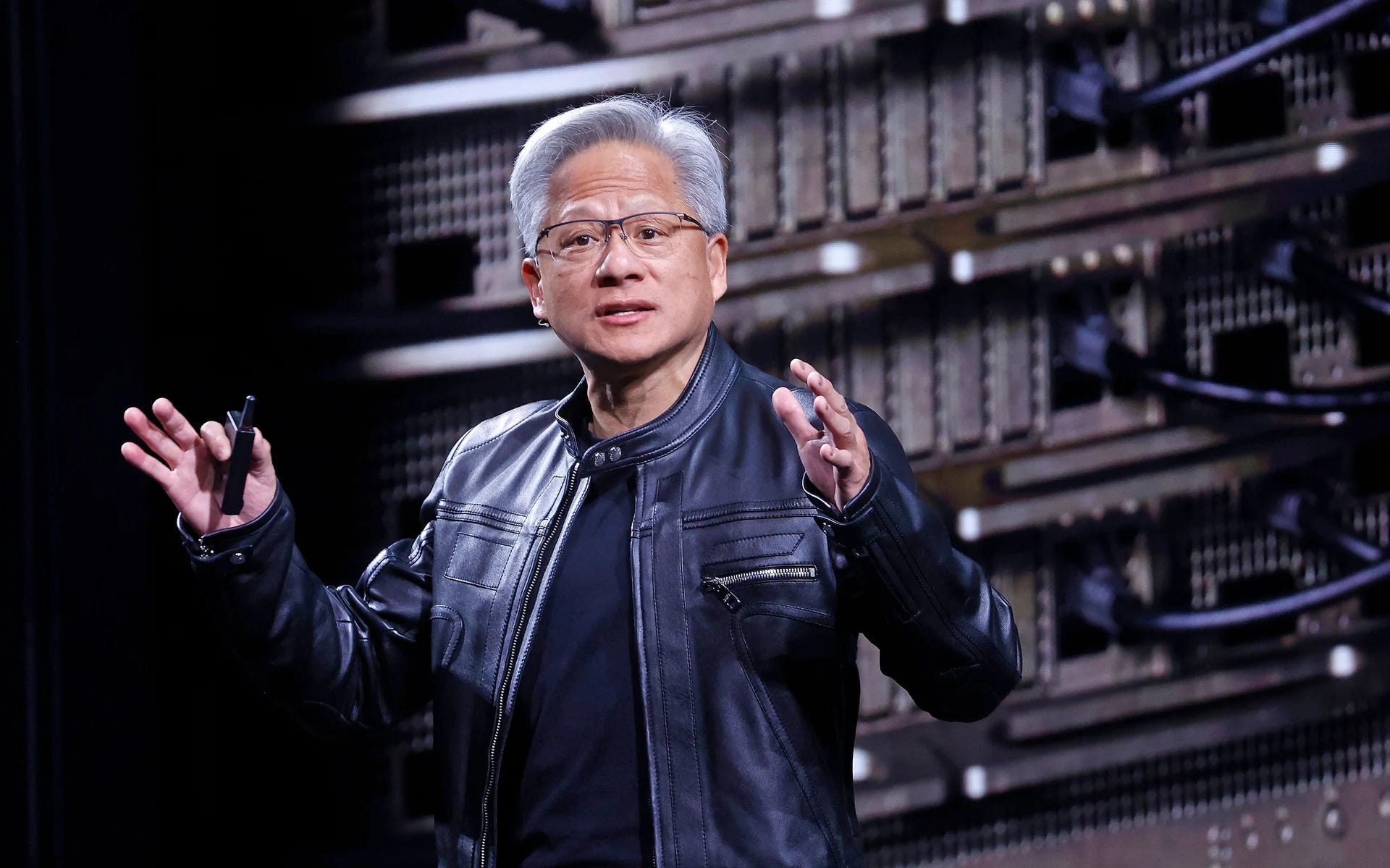
I saw this book shared in a Twitter post by PM Lawrence Wong and realized that despite being completely consumed by AI over the past few years, I have yet to read a book on Jensen Huang or Nvidia. Thus, I decided to read this and it was a pretty straightforward run-of-the-mill non-fiction book about a business leader written by a journalist. It wasn’t bad by any measure but it wasn’t that fun to read either. However, it does serve its purpose well as a sort of longer wikipedia page where you can mull over the life of the person running the most valued company in the world that is selling the shovels in history’s greatest gold rush.
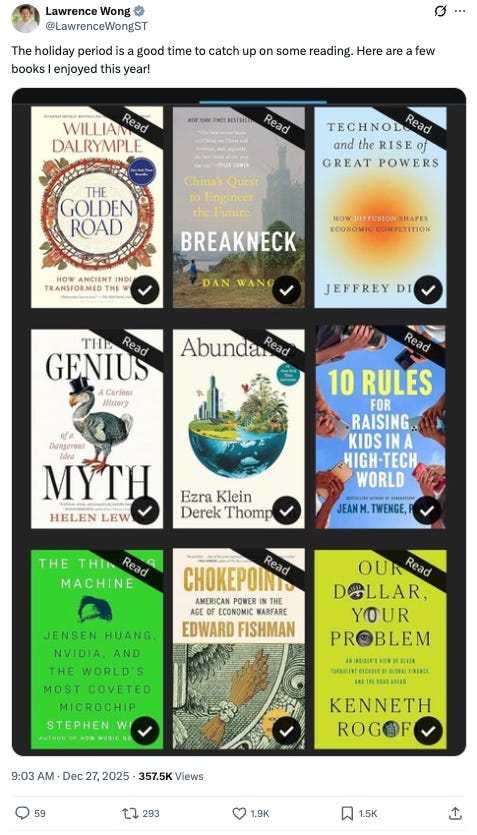
Compared to his big tech founder CEO peers, Jensen Huang is unique by being kind of ‘old school’ in that he wears the same black shirt and leather jacket everywhere and is known for publicly yelling at his employees when they mess up which is kinda stevejobscore. Also, throughout the book he constantly mentions that his main mantra that keeps him going is reminding himself and his employees that the company is always 30 days away from going bankrupt. It’s an interesting spin compared to the Jeff Bezos “Day One” mentality which is more optimistic in nature but this clearly works as well. The author asked him whether the trillions in market capitalization that Nvidia has added reduced this belief in the mantra but Jensen says that he still believes in it and that the stress keeps him going every day.
Another quirk that I found interesting was his preference for whiteboards over powerpoint presentations during meetings as he says it allows people to formulate their ideas clearly and they don’t waste time. It also serves as a reminder for them to constantly reinvent new things and to not rely on their past successes. Again, this reminded me of Bezos who famously banned powerpoint presentations and instead made everyone have a silent reading period where they would read a prepared memo together before starting discussions.
While the history of Jensen and Nvidia and the development of AI into what it has become today was all interesting with little backstories of every major leader and company, the book ended on a high note of sorts with a Jensen rant about his thoughts on AI and the future which was my personal highlight of the book.
The author mentions throughout the book the theories and predictions that various people have about what happens when AGI is achieved and how it will affect the future of jobs or even humanity. These questions are pretty standard and every leader in the AI space has their own answer that they have repeated thousands of times. In earlier interviews with the author, Jensen gave his usual spiel about how he didn’t think that developing more advanced AI would end the species and that he was more so interested in ensuring Nvidia keeps improving and innovating. However in his final interview with Jensen, the author asks the same question again but in a different way and Jensen got tired and here’s the passage from the book about what then transpired.
“I just feel like you’re interviewing the wrong person,” he said, quietly. “I feel like you’re interviewing Elon right now, and I’m just not that guy.” I paused, unsure what to say, but it was too late. I’d hit the trip wire.
“Is it going to—is it going to destroy jobs?” Huang asked, his voice crescendoing with anger. “Are calculators going to destroy math? That conversation is so old, and I’m so, so tired of it,” he said. “I don’t want to talk about it anymore! It’s the same conversation over and over and over and over and over again. We invented agriculture and then made the marginal cost of producing food zero. It was good for society! We manufactured electricity at scale, and it caused the marginal cost of chopping down trees, lighting fires, carrying fires and torches around to approximately zero, and we went off to do something else. And then we made the marginal cost of doing calculations—long division! We made it zero!” He was yelling now. “We make the marginal cost of things zero, generation after generation after generation, and this exact conversation happens every single time!”
“I tried to switch subjects, but it was no use. His anger was tinged with disgust. He began to lecture me in the voice that one would use with a wayward teenager. He’d placed high expectations in me, he said, and I had disappointed him. I had wasted his time; I had wasted everyone’s time; the whole project of the book was now called into question. The interview was attended by two of Jensen’s PR reps, but neither made any attempt to intervene—they weren’t about to draw fire.
Kirk had theorized that Huang’s anger was strategic. I can tell you, it didn’t feel that way in the moment. His anger seemed uncontained, omnidirectional, and wildly inappropriate. I was not Jensen’s employee, and he had nothing to gain from raging at me. He just seemed tired of being asked about the negative aspects of the tools he was building. He thought the question was stupid, and he had been asked it one too many times.
“This cannot be a ridiculous sci-fi story,” he said. He gestured to his frozen PR reps at the end of the table. “Do you guys understand? I didn’t grow up on a bunch of sci-fi stories, and this is not a sci-fi movie. These are serious people doing serious work!” he said. “This is not a freaking joke! This is not a repeat of Arthur C. Clarke. I didn’t read his fucking books. I don’t care about those books! It’s not—we’re not a sci-fi repeat! This company is not a manifestation of Star Trek! We are not doing those things! We are serious people, doing serious work. And—it’s just a serious company, and I’m a serious person, just doing serious work.”
“For the next twenty minutes, in a tone that alternated among accusatory, exasperated, and belittling, Jensen questioned my professionalism, questioned my interview approach, questioned my dedication to the project. He accused me of trying to psychoanalyze him; he told me how much he disliked answering my biographical questions, especially those that attempted to illuminate his mental state. “I don’t like these probing questions,” he said. “I don’t like talking about myself, OK?! I’m not into therapy.” He suggested that my questions were stupid; he called them “pedestrian.” He denied there was anything exceptional about himself, against all accumulated evidence. “Look, I’m—I am super normal,” he said.
“I have never met anyone like you,” I said.
“I’m super normal,” Huang said.
Gradually, the anger wore off. Huang changed topics a couple times, talking about upcoming products, asking after the welfare of his PR reps, and recalling the importance of the late John Nickolls to the CUDA project. At one point he brought up the Roman Empire. He continued to chide me gently—he was done with me—and I was ushered out the door. “I left the interview bewildered. I’d had plenty of tense conversations with executives, but I’d never had someone explode at me in this way. I was stunned—but also, if I’m being honest, I was a little giddy. To be targeted by the Wrath of Huang was in a certain sense an honor: a rite of passage that everyone who gained admittance to his inner circle underwent. Walking away from the conference room, I turned to one of the PR reps.
“That went well,” I said.
He laughed. “Oh, that?” he said. “That was nothing.”
I feel like this part alone made the book worth it to read. Yeah sure, it’s mostly a straightforward business book as I mentioned earlier but this interaction kind of sums up the core identity of Jensen. Well, at least the one that he wants to portray which I tend to believe.
Silicon Valley founders and especially AI founders grew up reading the great science fiction works of the late 20th century if they are older, or if they are younger, the rationalist writings of Eliezer Yudkowsky, Scott Alexander, and their adjacent network of thinkers. But clearly not Jensen.
The thing I learnt from this book is that Jensen Huang succeeded not because he had the grandest vision of what the future would look like and sold the dream to investors but because he is a guy who worked hard at hard problems for decades day in and out with the mindset that suffering is good. He was sent to the U.S. at 9 with just his brother and ended up at a religious reform school for troubled kids in Kentucky after his newly immigrated uncle mistook it for a prestigious boarding school and got beaten up daily for being a weird asian kid. He worked graveyard shifts at restaurant chain Denny’s through high school and college at nearby Oregon State because he couldn’t afford tuition elsewhere despite excelling in school. He took night classes at Stanford for his masters while working at various semiconductor companies through his 20s.
Basically he didn’t get to where he is in the AI industry by reading science fiction, posting on forums or selling grand stories and being a hype man. He defeated his competitors ruthlessly in the late 90s, then enjoyed the dot-com boom before the bust which led to NVDA decreasing by 90%. But Nvidia didn’t stop there, they continued working tirelessly and reinventing the company constantly by betting everything on contrarian projects like CUDA and the strategic pivot to deep learning hardware which created the bedrock for this entire industry.
Maybe I am just falling for his propaganda. But it’s a good one and Jensen Huang comes across as extremely human and real which makes it very hard to hate on him as his company continues to take over the world and create our future.